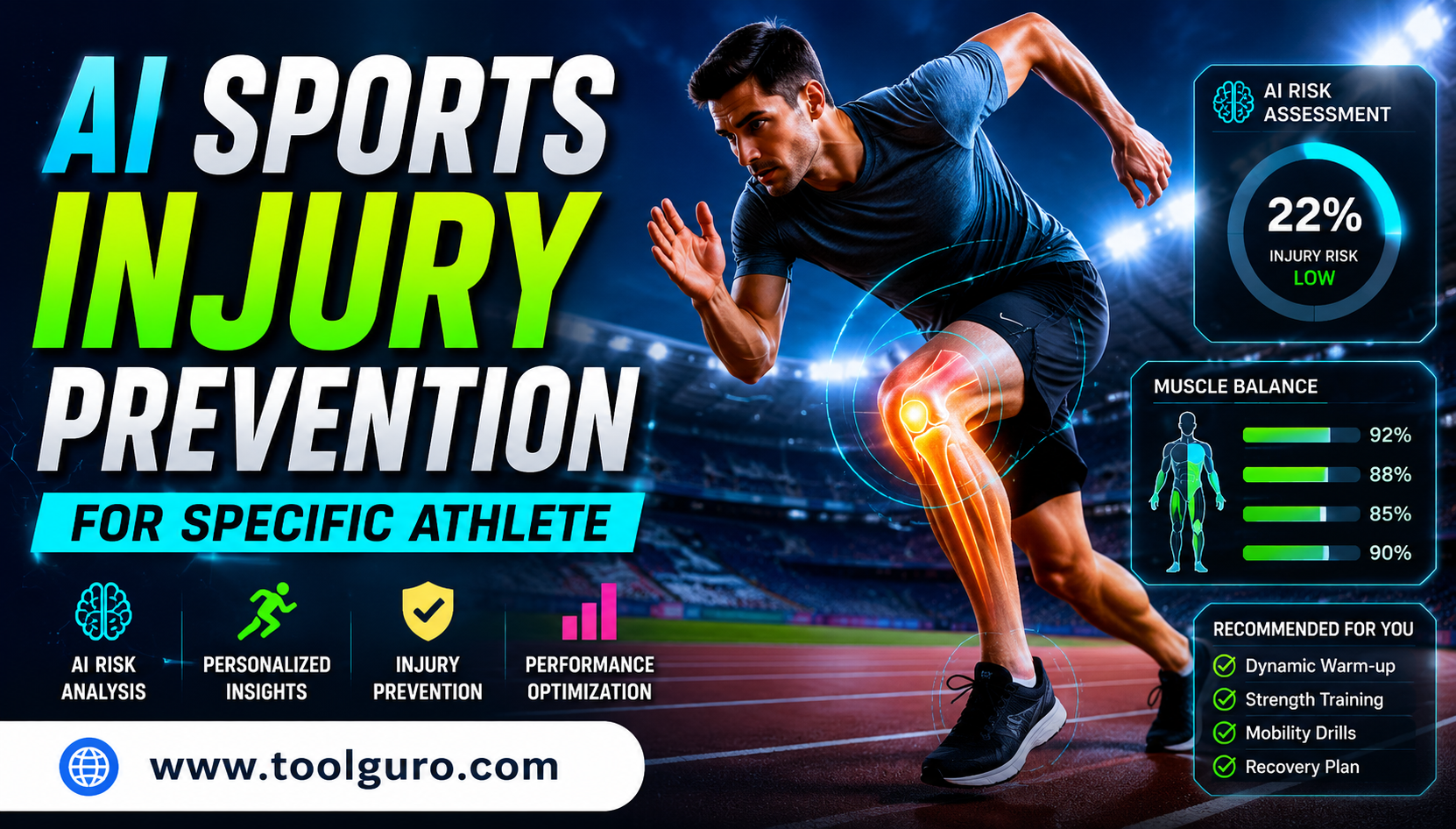
AI Sports Injury Prevention for Specific Athlete
Predict, Prevent, Perform: How AI Customizes Injury Prevention for Every Athlete
In the high-stakes world of sports today, the difference between a gold medal and a career-ending defeat is razor-thin. For decades, athletes, coaches, and sports scientists have been pursuing the sacred goal of athletic longevity: predicting injuries before they occur. Traditionally, injury prevention relied on general guidelines—broad rules about resting after running a few miles, universal stretching routines, or standard pitch counts. But this approach has a flaw: no two athletes are alike. A training load that builds excellent stamina in one athlete may cause a stress fracture in another.
AI Sports Injury Predictor
Hyper-Personalized Risk Mitigation Engine
Risk Zone
Enter Artificial Intelligence (AI). By shifting the paradigm from general sports science to hyper-personalized, data-driven insights, AI is revolutionizing the way we protect sports professionals. This article explains how AI-powered injury prevention adapts to a specific athlete's unique biometric, biomechanical, and psychological blueprint, ensuring they last longer on the field, court, or track.
The Key Problem: The Failure of "One-Size-Fits-All" Sports Medicine
Every individual has a unique combination of bone density, muscle fiber structure, joint laxity, and aging. When sports medicine treats athletes as a homogeneous group based solely on their sport or position, important insights are missed.
Traditional injury prevention approaches often look at macro-level data:
Average recovery time for a specific age group.
Standard hydration and nutritional baselines.
Common biomechanical checklists (e.g., "Keep your knees aligned").
While these guidelines are helpful baselines, they fail to account for individual impairments. For example, a particular basketball player may have a slight pelvic tilt due to a chronic ankle sprain. Under standard training loads, this small asymmetry may go unnoticed until it manifests as a debilitating hamstring tear. AI eliminates this blind spot by analyzing the athlete as an ecosystem.
How AI Understands a Specific Athlete: The Data Ecosystem
To protect an individual athlete, AI must first create their digital twin—a highly detailed virtual model of their physical state, updated in real time. This requires collecting a large stream of diverse data points for that specific individual.
- Computer Vision and Markerless Biomechanical Analysis
Instead of forcing athletes into lab settings filled with reflective tracking markers, modern AI uses advanced computer vision via standard high-definition cameras.
During practice or live games all AI tracks an athlete's skeletal joints in 3 dimensions. It analyzes the correct degree of joint rotation, ground reaction forces & landing symmetry. If a particular soccer player begins to extend their left leg just 2% too far during lateral cuts in the 70th minute of a match, the AI can detect this small mechanical flaw long before the human eye can detect it.
- Continuous Wearable Telemetry
Wearable devices have gone beyond standard step counters. Elite athletes now use integrated smart clothing, inertial measurement units (IMUs), and biometric patches. These devices continuously stream:
Heart rate variability (HRV): A direct indicator of autonomic nervous system fatigue.
Accelerometry data: Measuring the G-forces absorbed by an athlete's joints during acceleration and deceleration.
Sleep Architecture: Tracking deep and REM sleep cycles to predict tissue repair.
- Biochemical and Genetic Biomarkers
The most advanced AI models integrate internal biochemistry with external mechanics. By analyzing regular blood panels (monitoring cortisol, creatine kinase, and iron levels) and an athlete's genetic predisposition to soft-tissue injuries, the AI gains insight into how well a particular individual recovers from metabolic stress.
Predictive Modeling: The Math Behind Prevention
Once the data is available, machine learning algorithms begin to work. Instead of comparing the athlete to a global database, the AI compares the athlete to itself. This creates a highly calibrated baseline of what "healthy and optimal" looks like for that particular individual.
Acute-to-Chronic Workload Ratio (ACWR)
One of the most effective tools AI uses to automate and personalize training is the acute-to-chronic workload ratio.
A workshop load: An athlete undergoes a training regimen over a short period of time (typically 7 days).
Chronic workshop: The amount of training the athlete has undergone over a longer period of time (originally 28 days).
These workshops are designed using a mix of mechanical labs (heart rate, paced workload) and external workouts (timed distance, high-intensity sprints). If the AI detects that an athlete's acute workload has risen significantly above baseline—creating a dangerous imbalance—it immediately responds, liberalizing the percentages, and protecting the coaching staff.
Fortula Key Information: While a standard ACWR of 1.5 is generally considered the beginning of the "danger zone," AI has shown that a typical experienced athlete experiences greater soft-tissue risk at a 1.3 case ratio, while a younger athlete can comfortably handle 1.6.
Sport-Specific Customization: AI from Diplin's Account
Injury rates vary greatly across sports. The AI system is customized to focus on physician-based physical dosages and high-risk medications specific to an athlete's specific discipline.
| Sport | Primary Injury Risk Areas | What the AI Tracks for the Specific Athlete |
| Baseball (Pitchers) | UCL tears, rotator cuff strains | Shoulder distraction force, elbow valgus torque, release-point micro-shifts. |
| Soccer / Football | ACL tears, hamstring pulls | High-speed deceleration volume, pelvic asymmetry during cutting maneuvers. |
| Distance Running | Stress fractures, Achilles tendonitis | Vertical oscillation, ground contact time symmetry, foot-strike pattern shifts over distance. |
| Basketball | Ankle sprains, patellar tendonitis | Jump-landing force distribution, cumulative mechanical load per minute of play. |
Acute-to-Chronic Workload Ratio (ACWR)
One of the most effective tools AI uses to automate and personalize training is the acute-to-chronic workload ratio.A workshop load: An athlete undergoes a training regimen over a short period of time (typically 7 days).Chronic workshop: The amount of training the athlete has undergone over a longer period of time (originally 28 days).These workshops are designed using a mix of mechanical labs (heart rate, paced workload) and external workouts (timed distance, high-intensity sprints). If the AI detects that an athlete's acute workload has risen significantly above baseline—creating a dangerous imbalance—it immediately responds, liberalizing the percentages, and protecting the coaching staff.Fortula Key Information: While a standard ACWR of 1.5 is generally considered the beginning of the "danger zone," AI has shown that a typical experienced athlete experiences greater soft-tissue risk at a 1.3 case ratio, while a younger athlete can comfortably handle 1.6.Sport-Specific Customization: AI from Diplin's AccountInjury rates vary greatly across sports. The AI system is customized to focus on physician-based physical dosages and high-risk medications specific to an athlete's specific discipline.
Case Study Scenario: Elite Pitcher
Consider a Major League Baseball pitcher. Every time they throw a fastball, the ulnar collateral ligament (UCL) is subjected to a high torque. An AI specifically calibrated for this pitcher tracks the angular velocity of their elbow throughout the season.
If the AI detects that the pitcher's arm slot drops just one inch after 80 pitches—a signal of fatigue in the stabilizing shoulder muscles—it predicts a cascading risk to the elbow. The system generates a proactive recommendation: bench the pitcher for the next inning to avoid micro-tears.
Real-Time Intervention: From Insight to Action
Data is useless without actionable applications. The true value of AI in sports injury prevention lies in its ability to deliver real-time, prescriptive interventions tailored to the athlete's immediate schedule.
Morning Assessment: The athlete wakes up and syncs their wearable data. The AI analyzes their sleep efficiency, HRV, and self-reported muscle soreness.
Dynamic Routine Adjustment: If recovery metrics are low, the AI automatically rewrites the athlete's pre-practice warm-up, emphasizing targeted mobility exercises for previously weak areas (e.g., left hip activation).
Live Session Monitoring: During training, the strength and conditioning coach monitors a live dashboard. If the athlete's power output drops below a personalized threshold, the AI recommends shortening the session.
Optimized Post-Recovery Protocol: Based on the total mechanical and metabolic load endured throughout the day, the AI prescribes a custom recovery protocol—determining the appropriate timing for cold therapy, compression, and nutritional intake.
Addressing Challenges: Privacy, Trust, and the Human Factor
While the benefits of AI-based injury prevention are clear, implementing it at scale poses several significant challenges:
Data Privacy and Security
An athlete's biometric data is highly sensitive. If medical reports, genetic predispositions, and live fatigue levels are leaked, it could severely impact an athlete's market value, contract negotiations, and career opportunities. Strong, encrypted data governance frameworks are crucial to protecting athlete privacy.
The "Black Box" Problem
Coaches and athletic trainers hesitate to bench a star player during a championship run simply because an algorithm suggests so. AI tools must be "explainable"—they must clearly explain the rationale behind their risk assessments so that human professionals can trust and validate their recommendations.
Maintaining the Game's Intelligibility
Sports are driven by courage, determination, and human passion. There's a fine line between protecting an athlete and overly pampering them. AI should be viewed as an advisory tool, not a draconian dictator that takes away the psychological advantage needed to compete at the highest level.
Conclusion: The Future of Athletic Longevity
The integration of artificial intelligence into injury prevention in sports represents a definitive shift from a reactive medical model to a proactive performance model. We are moving beyond the days of waiting for an athlete's body to break down and then fixing it.
By continuously analyzing an individual, understanding their specific biomechanical weaknesses, and managing their specific training loads, AI ensures that athletes can safely push the limits of human performance. The future of sports belongs to those who use data not only to train harder, but also to train smarter—promoting long, healthy careers that redefine what the human body can achieve.